
The quote lands in your inbox and your stomach drops. One contractor says $6,000, another says $11,000, and a third refuses to give you a number until someone comes out. Same house, same broken air conditioner, completely different prices. If that’s where you are right now, take a breath, because the difference isn’t random.
AC replacement pricing comes down to more than the equipment sitting outside your home. System size, efficiency rating, installation complexity, ductwork, electrical requirements, and current refrigerant standards can all affect the final cost. Two homes can need the same size AC and still receive very different installation quotes.
Understanding these factors makes it easier to compare estimates and recognize what you’re actually paying for. The goal isn’t simply finding the cheapest replacement, but finding an appropriately sized system with an installation that supports reliable cooling and reasonable operating costs.
In this guide, you’ll learn what actually drives AC replacement costs in Elgin, IL, what you’re paying for in a replacement quote, which upgrades can push the price higher, and where homeowners can accidentally spend thousands more than necessary.
Key Takeaways
- Most Elgin AC replacements run $5,000 to $12,000 installed, depending on size, efficiency, and ductwork.
- Central AC installs average $2,000 to $3,000 per ton of cooling capacity in the Chicago metro.
- The 2025 R-410A phaseout raised new-equipment prices, so timing a replacement matters more now.
- Illinois requires a 13.4 SEER2 minimum, and a full replacement needs a City of Elgin permit.
- ComEd, Armstrong, and federal 25C incentives can cut thousands off a qualifying high-efficiency system.
What a New AC Costs in Elgin, IL
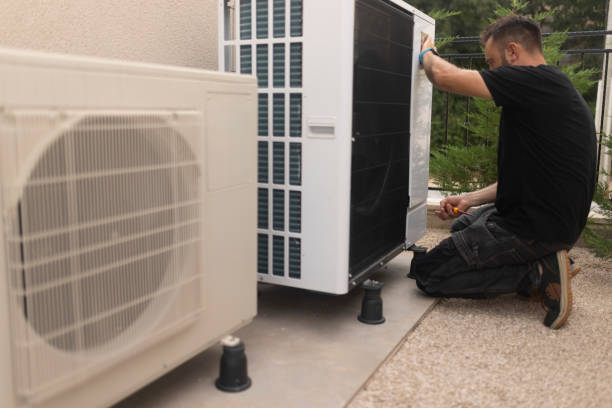
A straight answer first: most central air conditioner replacements in the Elgin area run $5,000 to $12,000 installed, and the average homeowner lands somewhere in the $6,600 to $9,500 range for a properly sized, mid-efficiency system. National install-cost data from HomeGuide’s 2026 AC replacement guide puts the full range at $3,000 to $15,000, and Kane County pricing sits close to the middle of that because local labor tracks the Chicago-metro average.
The cleanest way to sanity-check a quote is per ton. Installed central systems in this market average $2,000 to $3,000 per ton of cooling capacity. Here is roughly what that looks like by home size:
| System size | Typical home | Installed cost (AC only) |
| 2 ton | Up to ~1,200 sq ft | $4,500 – $7,000 |
| 3 ton | ~1,500-2,000 sq ft | $6,000 – $9,500 |
| 4 ton | ~2,000-2,800 sq ft | $8,000 – $12,000 |
| 5 ton | 2,800+ sq ft | $9,500 – $14,000 |
Two things to note. First, these are AC-only numbers. If your furnace is also aging and you replace both at once, add roughly $3,000 to $5,000, but you save on labor by doing it in one visit. Second, “AC only” still includes a new outdoor condenser, a matched indoor evaporator coil, refrigerant, a line-set connection, electrical, the permit, and startup. A quote that’s far below these ranges is usually missing one of those, so ask what’s included before you celebrate the low number.
What Actually Drives Your Replacement Price
Four factors explain almost every dollar of difference between two Elgin quotes. Knowing them turns a confusing spread into an apples-to-apples comparison.
System size (tonnage): Bigger is not better. An oversized AC short-cycles, cools unevenly, and never pulls enough humidity out of the air, which matters a lot in a humid Elgin summer. A right-sized system comes from a Manual J load calculation that accounts for your square footage, insulation, windows, and layout, not a guess based on the old unit. If a contractor sizes your system by glancing at the nameplate on the dead condenser, that’s a shortcut worth questioning.
Efficiency (SEER2 rating): This is the biggest lever you control. Illinois falls in the federal North region, where the legal minimum is 13.4 SEER2 for a new central AC. Stepping from that baseline to a mid-tier 16 to 17 SEER2 unit adds roughly $600 to $1,400 in equipment on a 3-ton system, and moving to an 18 to 20 SEER2 variable-speed unit adds another $800 to $1,600 on top. The trade-off is your monthly bill. A higher SEER2 unit costs more up front and less every cooling season, so the right pick depends on how long you plan to stay in the home.
Single-stage vs. two-stage vs. variable-speed: A single-stage unit is either full-blast or off. A two-stage runs a gentler low setting most of the time, and a variable-speed inverter modulates continuously for the steadiest temperature and best humidity control. Each step up adds comfort and cost. For a lot of Elgin homes, a two-stage system in the 16 to 17 SEER2 range hits the sweet spot.
Ductwork and installation complexity: If your ducts are leaky, undersized, or need modification, that adds cost, but it also protects the investment, because a great AC on bad ducts underperforms. A tight attic, a cramped mechanical closet, or a long line-set run all add labor too. This is why an in-home assessment beats a phone quote every time.
The 2026 Refrigerant Change That Makes Timing Matter
Here is the piece most cost articles skip, and it changes the calculus for anyone on the fence. As of January 2025, manufacturers stopped building new air conditioners that use R-410A refrigerant under the federal AIM Act. New systems now ship with low-global-warming A2L refrigerants like R-454B.
That transition raised equipment prices. Industry estimates put the increase at 35 to 40 percent on some new A2L systems compared to the outgoing R-410A models, which for a full central system can mean thousands of dollars. The takeaway is not “panic buy.” It’s that the era of cheap R-410A equipment is over, so waiting three more summers with a dying unit no longer saves you money on the eventual replacement.
There’s a second angle for anyone limping along on an old system. If your current AC uses R-410A and springs a major leak, recharging it is getting more expensive every year as supply tightens, with the refrigerant now averaging $40 to $75 per pound.
And an R-410A system cannot be retrofitted to the new refrigerants, which is illegal and technically impossible. So a big repair on an aging R-410A unit often makes replacement the smarter spend. If your system still runs on R-22, the refrigerant banned from production in 2020, replacement is almost always the answer, because R-22 recharges are now brutally expensive.
Elgin Permits and Code: What a Legitimate Install Includes
A real replacement quote in Elgin includes a permit. A full AC installation or replacement requires one from the Building and Development Services Division of the City of Elgin’s Community Development Department. You can confirm the current requirements on the City of Elgin permits page or by calling 3-1-1 within the city. A repair does not need a permit, but swapping the whole system does.
This is not red tape for its own sake. The permit triggers an inspection that confirms the work meets code, which protects you and matters when you sell the house, since unpermitted HVAC work can surface during a home sale and stall it. Elgin also requires HVAC contractors to carry a $20,000 permit bond with the city and hold a valid Illinois HVAC license, and refrigerant handling legally requires EPA 608 certification. If a bid comes in suspiciously low because the contractor plans to skip the permit, that saving can cost you far more later.
Code sets the floor on efficiency too. Because Illinois sits in the North region, any new central AC installed here must meet at least 13.4 SEER2. A reputable Elgin installer, including Premier Comfort Heating and Air Conditioning, Inc., will fold the permit, the inspection, and code-compliant equipment into the quote rather than treating them as surprise add-ons.
Rebates and Tax Credits That Lower Your Elgin AC Replacement Cost
This is where the sticker price and the real price separate, sometimes by thousands of dollars. Stack the right incentives and a high-efficiency system can land close to what a basic one would have cost.
ComEd rebates: Through its energy-efficiency program, ComEd offers rebates on qualifying high-efficiency central air conditioners and air-source heat pumps, generally units rated around 18 SEER2 or higher. The catch that trips people up: the installer has to be an enrolled ComEd Trade Ally, so confirm that before you sign.
Manufacturer rebates: Premier Comfort Heating and Air Conditioning, Inc. is an Armstrong Authorized Dealer and runs Armstrong Air promotions with consumer rebates that have reached up to $1,000 on qualifying systems. These come and go seasonally, so ask what’s active when you get your quote.
Federal tax credit: The Energy Efficient Home Improvement Credit (25C) returns 30 percent of the cost of qualifying high-efficiency equipment, up to a $600 annual cap for a central air conditioner, on your federal taxes. It’s a credit, not a rebate, so it lowers your tax bill the following year.
Financing. For a planned upgrade or an emergency failure in July, Premier Comfort Heating and Air Conditioning, Inc. offers financing on approved credit, which spreads the cost into monthly payments instead of one lump sum. Between a ComEd rebate, a manufacturer rebate, the federal credit, and financing, the gap between a basic unit and an efficient one narrows fast.
Repair vs. Replace: When Upgrading Actually Pays Off
Not every failing AC needs replacing. The rule of thumb that holds up is the “$5,000 rule”: multiply the repair cost by the age of the unit in years. If the total tops $5,000, replacement usually wins. A $700 repair on a 6-year-old unit is $4,200, so you fix it. That same repair on a 13-year-old unit is $9,100, so you replace it.
Age drives this for a reason beyond math. Most central AC systems in this climate last 12 to 15 years, and Elgin’s freeze-thaw winters plus humid summers wear outdoor condensers hard. A unit pushing 15 is on borrowed time no matter what specifically broke. There’s also an efficiency dividend: a 15-year-old system running at 10 SEER replaced with a 17 SEER2 unit can cut cooling costs meaningfully, so part of the replacement pays for itself on the ComEd bill each summer.
The honest version: if your AC is young, uses R-410A, and needs a modest repair, fix it. If it’s over 12 years old, needs an expensive repair, or runs on R-22, price a replacement and check the incentives before deciding.
Signs Your Elgin AC Is Ready for Replacement
A few clear signals mean it’s time to stop repairing and start planning a new system:
- The unit is 12 to 15 years old, especially if repairs are stacking up
- It runs on R-22 refrigerant, now expensive and out of production
- Cooling is uneven, or the house never quite dries out on humid days
- Energy bills climb each summer with no change in your habits
- You’ve paid for two or more repairs in the last two cooling seasons
One or two of these means get an assessment. Three or more means replacement is likely the better long-term spend, and pricing it before the unit dies entirely lets you shop calmly instead of paying emergency rates in a heat wave.
How to Get an AC Replacement Quote You Can Trust in Elgin
The wide spread in quotes is not proof someone is ripping you off. It usually means the bids are for different systems: different tonnage, different efficiency, some including ductwork or a permit and some quietly leaving them out.
The way to compare fairly is to make every contractor spell out the tonnage, the SEER2 rating, the stage type, whether the permit and inspection are included, and which rebates apply. Once those line up, the real price differences get small and easy to judge. And insist on an in-home load calculation, because a system sized off the old nameplate is a guess you’ll live with for 15 years.
For homeowners who’d rather skip the guesswork, Premier Comfort Heating and Air Conditioning, Inc. is a local, family-owned, licensed and bonded Elgin company, an Armstrong Authorized Dealer and Mitsubishi Diamond Contractor with a 4.7-star rating across 233 reviews, financing on approved credit, and a 10-Year No Lemon Guarantee on the compressor and heat exchanger.
To get a right-sized, code-compliant quote with the permit, rebates, and financing laid out clearly, request your free estimate or call 224-305-0601 and get a straight number before the next Elgin heat wave hits.
FAQ
How much does it cost to replace a central AC in Elgin, IL?
Most replacements run $5,000 to $12,000 installed, with the average homeowner around $6,600 to $9,500 for a right-sized, mid-efficiency system. Size, SEER2 rating, and any ductwork drive the final number.
Do I need a permit to replace my AC in Elgin?
Yes. A full AC replacement or new installation requires a permit from the City of Elgin’s Building and Development Services Division, which triggers a code inspection. A repair does not require a permit, but a whole-system swap does.
What SEER2 rating do I need in Illinois?
Illinois is in the federal North region, where the legal minimum for a new central AC is 13.4 SEER2. Many homeowners choose 16 to 18 SEER2 for lower summer bills and to qualify for ComEd rebates.
Should I replace my AC and furnace at the same time?
Often yes, if both are aging. Replacing them together adds roughly $3,000 to $5,000 over an AC-only job but saves on labor and ensures the two components are properly matched for efficiency.
Will the 2026 refrigerant change affect my new AC?
Yes. New systems now use A2L refrigerants like R-454B instead of R-410A, which raised equipment prices by an estimated 35 to 40 percent on some models. Waiting to replace a dying unit no longer saves money on the equipment.
Are there rebates for a new AC in Elgin?
Yes. ComEd offers rebates on qualifying high-efficiency systems installed by an enrolled Trade Ally, Armstrong runs manufacturer rebates up to $1,000, and the federal 25C credit covers 30 percent of qualifying equipment up to a $600 cap for central AC.